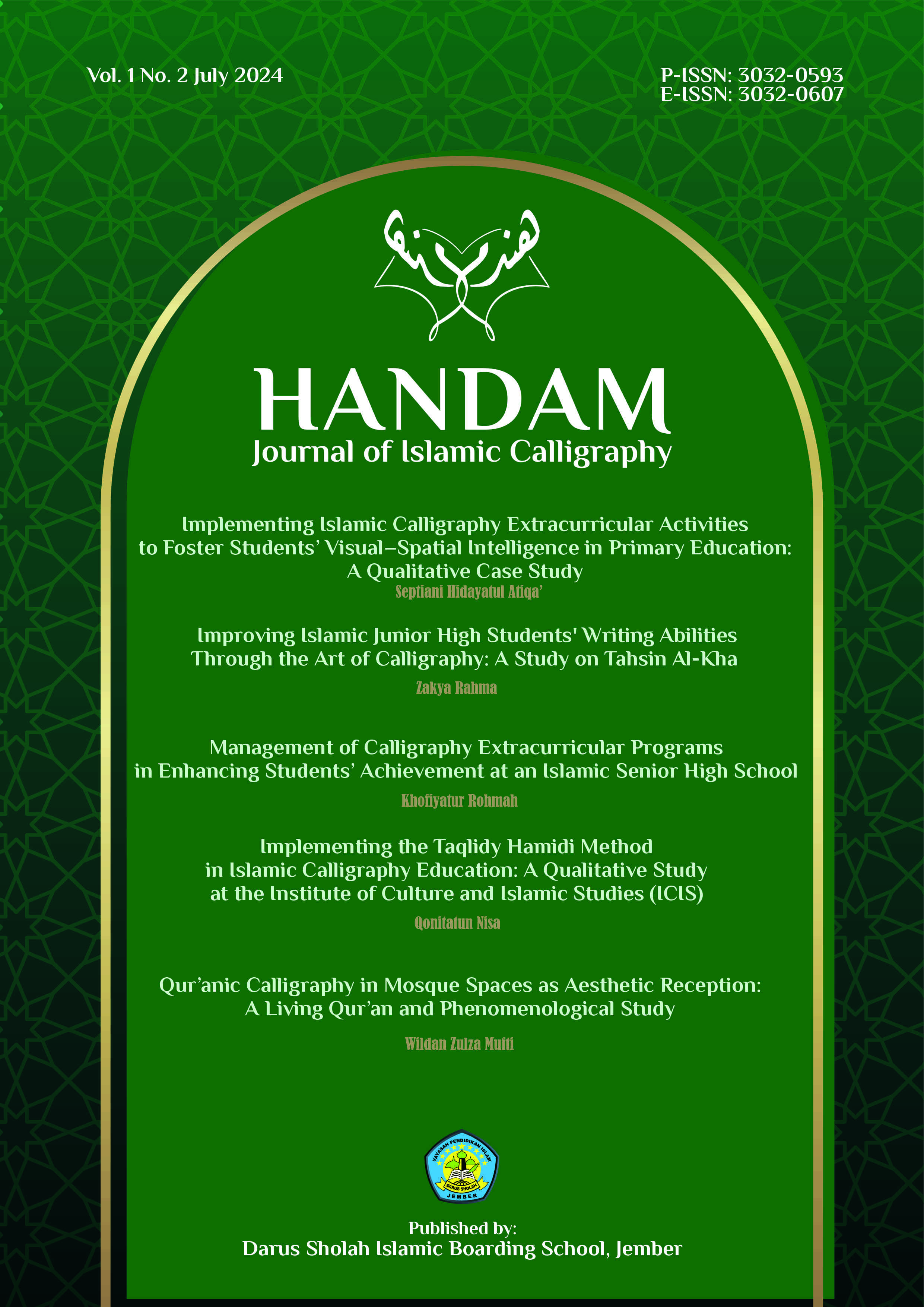
Implementing Islamic Calligraphy Extracurricular Activities to Foster Students’ Visual–Spatial Intelligence in Primary Education: A Qualitative Case Study
Keywords:
Extracurricular Activities, calligraphy, visual-spatial intelligenceAbstract
This study explores the implementation of Islamic calligraphy extracurricular activities as a strategy to develop students’ visual–spatial intelligence in an Islamic primary school context. Grounded in the multiple intelligences framework, the research aims to examine the planning, instructional practices, evaluation processes, and contextual factors influencing the effectiveness of calligraphy-based learning. Employing a qualitative case study design, data were collected through classroom observations, semi-structured interviews with school leaders, instructors, and students, as well as document analysis. The findings reveal that calligraphy extracurricular activities were systematically planned to integrate artistic learning with Islamic values and were implemented through demonstration, guided practice, and continuous feedback. Students demonstrated increased engagement, improved spatial awareness, enhanced creativity, and stronger learning discipline throughout the program. Evaluation was conducted through authentic and process-oriented assessment focusing on students’ artistic development rather than numerical achievement. Supporting factors included institutional commitment, students’ intrinsic interest, and parental encouragement, while limited instructional time and facility constraints emerged as inhibiting factors. The study highlights the pedagogical potential of Islamic calligraphy as an alternative learning pathway for fostering visual–spatial intelligence and promoting holistic student development in primary education.
Downloads
Published
Issue
Section
License
Copyright (c) 2024 Handam: Journal of Islamic Calligraphy

This work is licensed under a Creative Commons Attribution-ShareAlike 4.0 International License.


 Email: smppds99@gmail.com