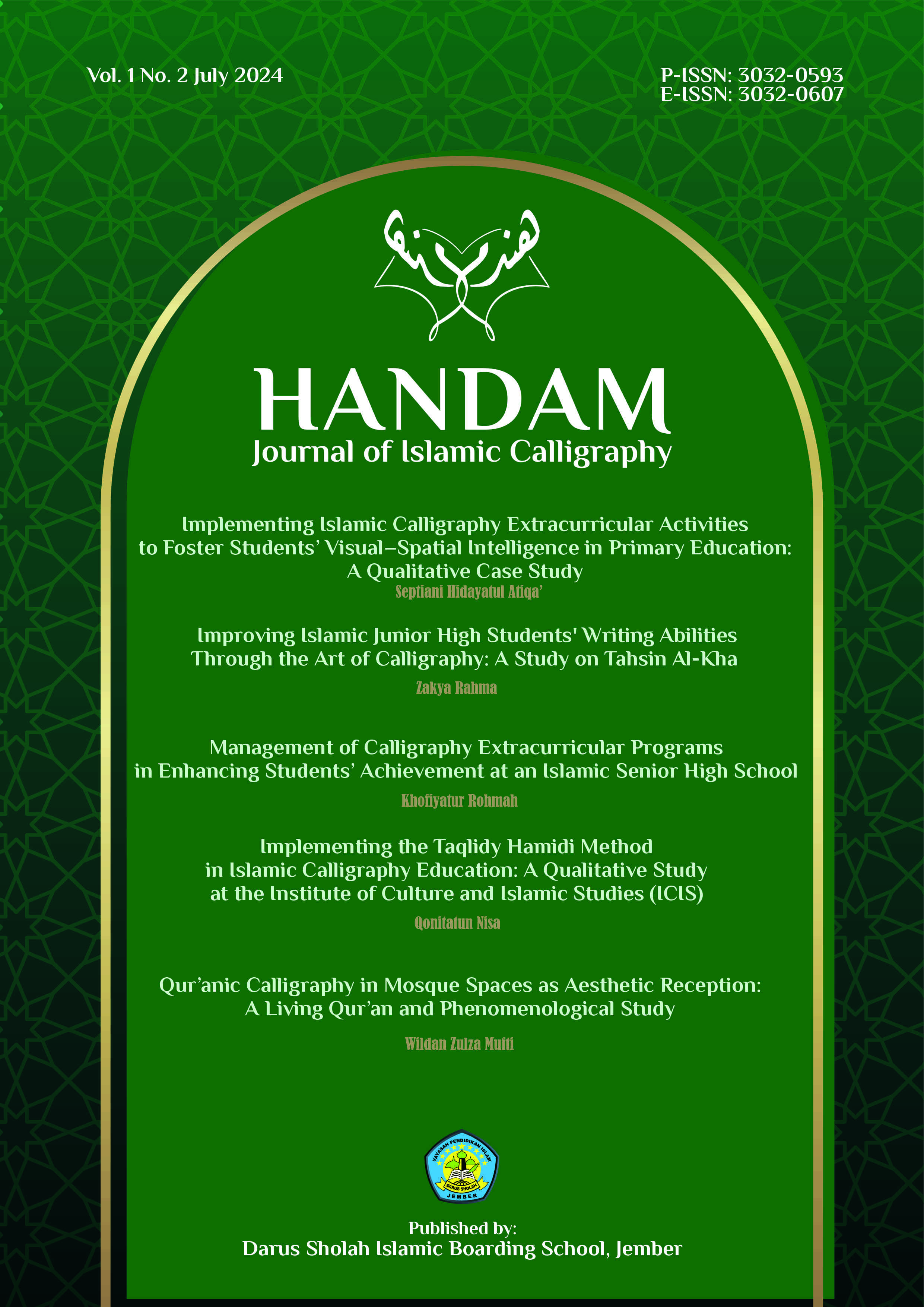
Implementing the Taqlidy Hamidi Method in Islamic Calligraphy Education: A Qualitative Study at the Institute of Culture and Islamic Studies (ICIS)
Keywords:
Islamic calligraphy, taqlidy hamidi method, khat riq‘ah, Islamic art educationAbstract
Islamic calligraphy represents a central artistic and educational tradition in Islamic culture, combining aesthetic beauty with disciplined craftsmanship and spiritual values. This study aims to analyze the implementation of Islamic calligraphy learning using the Taqlidy Hamidi method at the Institute of Culture and Islamic Studies (ICIS), IAIN Jember. Employing a qualitative descriptive approach, data were collected through observations, semi-structured interviews, and documentation involving calligraphy instructors, tutors, and students. The findings reveal that the Taqlidy Hamidi method is implemented through systematic and gradual instructional stages, beginning with Khat Riq‘ah as a foundational script, followed by mastery of basic letterforms (mufradat), letter connections (tarkib), and continuous formative evaluation. A distinctive feature of this method is the murosim ijazah, which functions as both summative assessment and symbolic legitimization of students’ competence. The study also finds that the method effectively enhances students’ technical skills, aesthetic sensitivity, discipline, and perseverance. Supported by institutional structures and qualified instructors, the Taqlidy Hamidi method demonstrates strong relevance for contemporary Islamic art education while preserving classical calligraphic traditions. This research contributes to the discourse on traditional pedagogical models in higher education and offers insights for the development of structured Islamic calligraphy learning.
Downloads
Published
Issue
Section
License
Copyright (c) 2024 Handam: Journal of Islamic Calligraphy

This work is licensed under a Creative Commons Attribution-ShareAlike 4.0 International License.


 Email: smppds99@gmail.com