Vol. 2 No. 2 (2025): Handam: Journal of Islamic Calligraphy
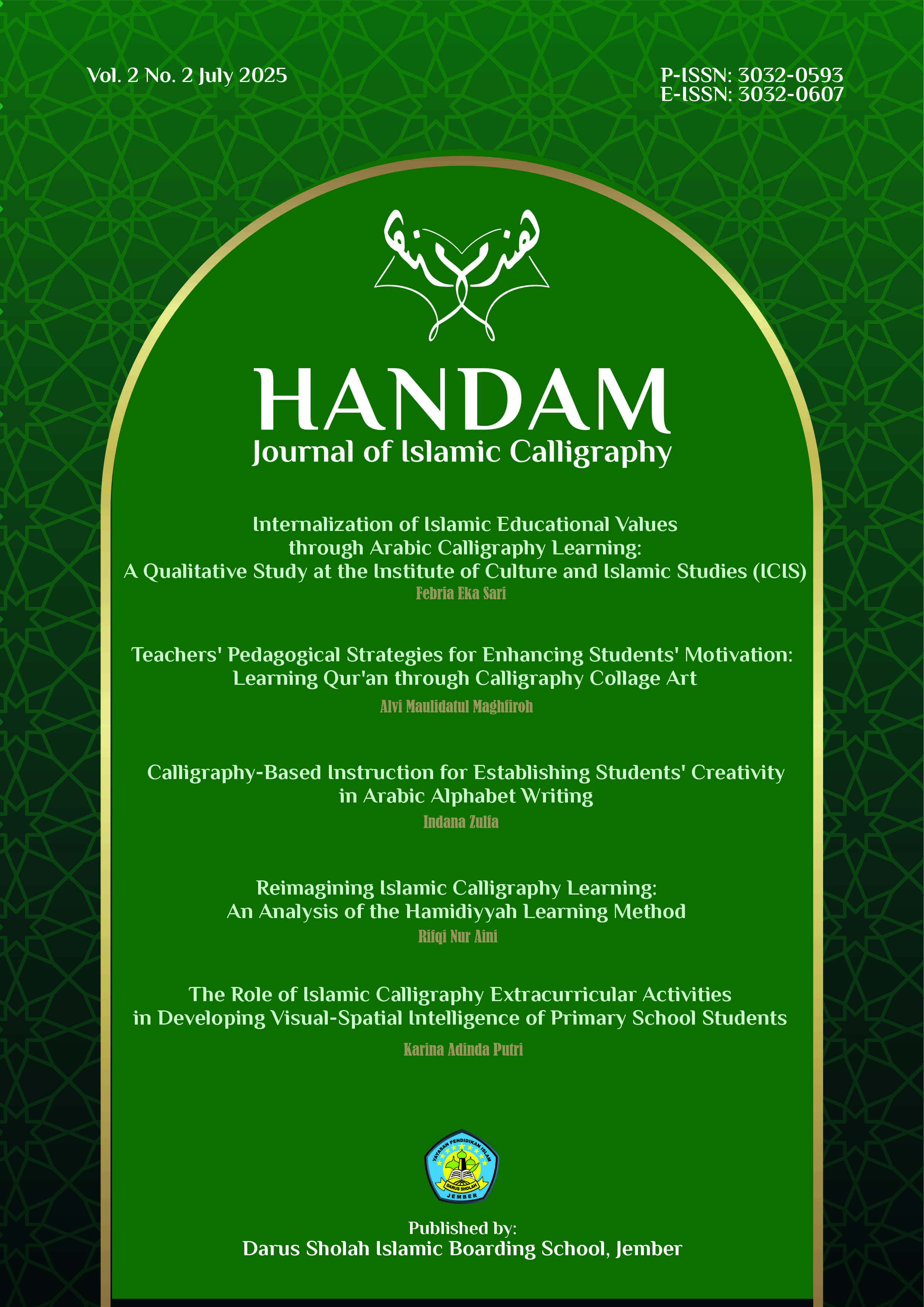
This issue presents a collection of studies that examine the role of Islamic calligraphy in educational development, pedagogical innovation, and character formation within Islamic learning environments. Several articles explore how calligraphy learning can serve as an effective medium for internalizing Islamic educational values and fostering students’ moral and intellectual growth. One qualitative study conducted at the Institute of Culture and Islamic Studies (ICIS) highlights how Arabic calligraphy learning contributes to the internalization of Islamic values through disciplined practice, aesthetic appreciation, and spiritual reflection.
Other contributions focus on teaching strategies and instructional methods designed to enhance student engagement and motivation. One article investigates teachers’ pedagogical approaches in teaching Qur’anic content through calligraphy collage art, demonstrating how creative activities can increase students’ motivation and participation in learning. Another study discusses calligraphy-based instruction as a means of strengthening students’ creativity in writing the Arabic alphabet.
In addition, a conceptual analysis of the Hamidiyyah learning method offers insights into innovative approaches to Islamic calligraphy education and its pedagogical foundations. Finally, research on extracurricular calligraphy activities in primary schools shows their potential to develop students’ visual–spatial intelligence and artistic sensitivity. Overall, the articles in this issue highlight the educational, creative, and character-building potential of Islamic calligraphy in contemporary Islamic education.
Published:
31-07-2025


 Email: smppds99@gmail.com